 |
| |||||||||||
|

RPS HistoryThe Society and Beethoven
The Society and Beethoven
'I am now writing a new symphony for the Philharmonic Society, and hope to have it finished within two weeks.'
(Beethoven to Archduke Rudolf, 1 July 1823)'One Hundred Pounds…to some confidential friend of Beethoven, to be applied to his comforts and necessities during his illness. Carried Unanimously.'
(Directors' Minute, 28 February 1827)Beethoven's music was regularly performed at the concerts of the Philharmonic Society from its foundation in 1813. First performances in Britain given by the Society include the Fifth Symphony (1816), Seventh Symphony (1817) and Piano Concertos 1 (1822), 3 (1824) and 4 (1825).
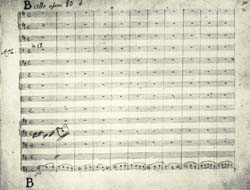
The front page of Beethoven's 9th SymphonyThe Society was soon in direct contact with the composer and in 1817 the Directors invited him to come to London to direct two symphonies to be composed by him for the Society. Negotiations were protracted and sadly the project was never realised. However in 1824, in response to a commission for 50 guineas, a manuscript score of his Ninth Symphony (The Choral) was sent to the Society bearing on its front page, in Beethoven's hand the dedication 'written for the Philharmonic Society in London'. The first British performance of the work was given in a Philharmonic Society concert on 21 March 1825.
Two years later, when the Society learnt that Beethoven was both ill and much in need of money, the Directors decided that a sum of £100 should be sent to him "to be applied to his comforts and necessities". The money, held up en route, reached him only a few days before he died, but time enough for him to express his heartfelt appreciation to the Society. Schindler, his amanuensis, reported that 'the Society had comforted his last days, and that event on the brink of the grave he thanked the Society and the whole English nation for the great gift, God bless them,'
Yet a further link with Beethoven can still be seen at every Royal Philharmonic Society concert. A bust of Beethoven by F Schaller of Vienna is traditionally placed on the platform at each concert. The bust was presented to the Society in 1870 by Madame Fanny Linzbauer of Budapest, wife of a University professor and a lady of artistic tastes, in recognition of the Society's kindness to Beethoven during the last years of his life. In Madame Linzbauer's words, "England will ever be considered the highest and best friend of that man, who was so much distinguished by nature."
The Society commemorated the centenary of Beethoven's birth by the creation of a Gold Medal for presentation to "artists of eminence". The medal bears the effigy of Beethoven, and has become one of the most privileged honours in the world of music.










|
The
Royal Philharmonic Society 10 Stratford Place, London, W1C 1BA Tel: +44 (0) 20 7491 8110 Fax: +44 (0) 20 7493 7463 Site design by Web Projects |