 |
| |||||||||||
|

RPS HistoryThe Society and Beethoven
Mendelssohn The Gentle Genius
by Christopher Kite"That smoky nest is fated for ever to be my favourite residence". So said Mendelssohn of London, to which he made some ten visits from 1829 onwards, primarily at the invitation of the Philharmonic Society. The spontaneous enthusiasm of London's musical world greatly impressed the 20 year-old composer: "London is the grandest and most complicated monster on the face of the earth... Things roll and whirl round me and carry me along as in a vortex."
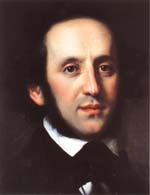
Felix MendelssohnAfter his visit to London in 1832, Mendelssohn was commissioned by the Philharmonic Society to compose a symphony, an overture and a vocal piece for the sum of 100 guineas. He returned in April 1833 with the Italian Symphony and not one but two overtures; the concert aria 'Infelice', however, was not to be written for another year. The performance took place on 13 May, when Mendelssohn also played Mozart's D minor Piano Concerto. 1842 saw a performance of the Scottish Symphony under the aegis of the Philharmonic Society on 13 June, and a later concert that season included the Hebrides Overture and his own D minor Piano Concerto. This was Mendelssohn's sixth visit, and a fish dinner was given in his honour. He was also invited to Buckingham Palace, where Queen Victoria sang and Prince Albert manipulated the organ stops. 1844 was a less happy occasion. Mendelssohn returned to conduct a series of five concerts, so paving the way for the appointment of a permanent director in the person of Costa two years later. The orchestra, however, earned itself an unfortunate place in musical history by refusing to take Schubert's C major Symphony seriously. It was typical of Mendelssohn's personality that he later resisted the dismissal of players who had behaved disrespectfully towards him. His pleasant, cultured manner and unfailing politeness and tact endeared him to English sensibilities just as much as the urbane polish, geniality and effortless melodiousness of his music.
Those who recognise artistry only in confrontation à la Beethoven or Wagner fail to appreciate Mendelssohn's virtues. His musicianship and personality made him an outstanding and authoritative conductor; here too, his primary aim was smoothness and elegance. "Frisch, immer vorwärts" was his motto, and of course, it is true that quick tempi are better suited to skimming over imperfections! Mendelssohn was essentially a pragmatist; he kept the more restless and volatile aspects of his temperament in check, and he accommodated his own scrupulous and fastidious nature to the realities of musical performance. For this we should not judge him too unkindly.
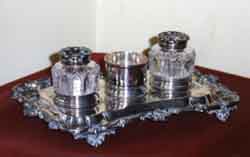
A silver desk set presented to Mendelssohn by the RPS










|
The
Royal Philharmonic Society 10 Stratford Place, London, W1C 1BA Tel: +44 (0) 20 7491 8110 Fax: +44 (0) 20 7493 7463 Site design by Web Projects |