 |
| |||||||||||
|

RPS HistoryThe Society and Beethoven
Royal Philharmonic Society History
by Arthur Searle (RPS Honorary Librarian)
Joseph Haydn paid two lengthy visits to England in the years 1791/5. (Between them, in Vienna, he received the young Beethoven as a pupil.) Haydn found London's varied musical life stimulating; in return, the appreciation of orchestral music in the capital benefited immeasurably from the symphonies which he wrote for Johann Peter Salomon's concerts.
Despite the war in Europe, a number of short-lived bodies gave orchestral concerts in the following years, often with Salomon taking part. But there was no regular pattern. In 1813 a group of professional musicians banded together to put matters right. This was the genesis of the Philharmonic Society of London, which became the Royal Philharmonic Society during its one-hundredth season of concerts in 1912. Salomon led the orchestra at the first concert, and Muzio Clementi 'presided' at the piano, just as Haydn had done. Other founder-members included Sir George Smart, who was to play an active part in the Society's affairs until the 1860s, the violinist and composer Felix Janiewicz, Mozart's English pupil Thomas Attwood, and Charles Neate, who went to Vienna to study with Beethoven after the war had ended two years later.
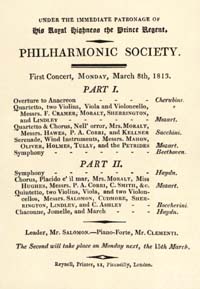
Programme from the inaugural RPS concertFrom the beginning, and with remarkably few interruptions, the Society gave a regular season of eight concerts. New music was the principal interest. That first concert, on 8 March 1813, included symphonies by Haydn and Beethoven, and chamber and vocal works by Mozart. It began with the overture to Cherubini's opera-ballet Anacreon. The concerts for the second season included a new overture by Cherubini specially written for the Society, and a new symphony by Ferdinand Ries, another Beethoven pupil living in London.
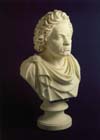
The RPS's Schaller bust of BeethovenContact between the Society and Beethoven was first established through Neate in 1815, and renewed in 1817 through Ries. Beethoven was never able to accept the Society's invitation to come to London, so that the experience of Haydn's stay was not recreated. But the link culminated in the Society's request in 1822 for a new symphony, which was met in December 1824 by the arrival of a score of the 'Choral' Symphony bearing in Beethoven's hand the words 'geschrieben für die philharmoniscbe Gesellschaft in London'.
Though Beethoven could not come, other European composers were able to make the journey to London for the Society's concerts. Among the most outstanding in the early years were Cherubini, Spohr, Weber and Mendelssohn. Mendelssohn wrote the Italian Symphony for the Society and conducted its first performance in London on 13 May 1833.
The Philharmonic continued this tradition by inviting Berlioz to conduct a programme of his works in 1853, by engaging Wagner as conductor for the whole of the 1855 season (an exercise which met with some criticism), and by presenting Tchaikovsky as conductor of his own works in 1888 and 1893. Many lesser European figures took part, and the concerts also promoted the works of British composers and continued to be based on the services of outstanding English conductors, soloists and orchestral musicians. International recognition of these activities came with the presentation to the Society in Beethoven's centenary year, 1870, of Schaller's dramatic bust of the great composer. From that year the Society used the award of its Gold Medal, representing the bust in profile, to reward outstanding musicians. After the first awards to Sterndale Bennett, Gounod, Joachim and Madame Linzbauer, the donor of the bust, the roster, to select almost at random, includes Brahms, Paderewski, Clara Butt, Kreisler, Henry Wood, Delius, Elgar, Beecham, Vaughan Williams, Holst, Bax, Rachmaninoff, Sibelius, Richard Strauss, Toscanini, Prokofiev, Boult, Britten and Stravinsky.
The mixture of British and European names underlines the continuing significance of the work of the Royal Philharmonic Society in current times. The position inevitably changed once the Society ceased to have its own orchestra. But since the second world war it has taken on an additional role in the administration of a number of musical awards, and, while no longer promoting its own concert series, continues to support concerts which introduce new and unfamiliar music from around the world. Among the most recent gold medallists are Tippett, Menuhin, Messiaen, Rostropovich, Lutoslawski, Brendel, Boulez, Domingo and Rattle.









|
The
Royal Philharmonic Society 10 Stratford Place, London, W1C 1BA Tel: +44 (0) 20 7491 8110 Fax: +44 (0) 20 7493 7463 Site design by Web Projects |